Research Findings
May 30, 2025

Yale Study Overturns Decades of Dogma: T Cells Live in the Healthy Brain Via a Gut-Fat-Brain Axis

In a landmark study published in Nature on May 28, 2025, Yale School of Medicine researchers have overturned one of immunology’s long-held assumptions: that T cells only enter the brain in response to disease. The study — supported in part by the Colton Center for Autoimmunity at Yale — provides the first definitive evidence that T cells reside in the healthy brains of both mice and humans, trafficked there via a newly identified gut-fat-brain axis.

The team, led by doctoral student Tomomi Yoshida, Professor David Hafler, and Associate Professor Andrew Wang, found T cells most densely concentrated in the subfornical organ — a small, deep-brain region that regulates thirst and hunger, and where the blood-brain barrier is slightly more permeable than elsewhere. The T cells found there closely resembled those in the gut and fat tissue, not those in the brain’s surrounding membranes, suggesting a distinct trafficking pathway from the periphery to the brain.

In mice, the migration of gut T cells to the brain was triggered by weaning and the accompanying shift in the gut microbiome. Germ-free mice — raised without any gut bacteria — had no T cells in their brains at all. And when researchers depleted the brain T cells, the mice’s food-seeking behavior changed noticeably following a short fast, suggesting the cells play a functional role in communicating the body’s nutritional state to the brain.

The researchers believe the T cells may act as living messengers — carrying real-time information about the gut microbiome and metabolic state directly to the brain, representing an entirely new mode of gut-brain communication with potential implications for autoimmune neurological diseases including multiple sclerosis.

Research FindingsAnimal ModelsBiological & MechanisticExperimental Platforms & ModelsMicrobiome–Immune InteractionsNeuro-Immune InteractionsT Cell BiologyMultiple SclerosisNeurologic DiseasesYale University

Featured Experts

Katsuo Kurabayashi, PhD

Katsuo Kurabayashi, PhD

Colton Consortium Member

Department Chair, Mechanical and Aerospace Engineering, NYU Tandon School of Engineering

Carla R. Nowosad, PhD

Carla R. Nowosad, PhD

Colton Consortium Member

Assistant Professor, Department of Pathology, NYU Grossman School of Medicine / NYU Langone Health

Jun Wang, PhD

Jun Wang, PhD

Colton Consortium Member

Associate Professor, Department of Pathology, NYU Grossman School of Medicine / NYU Langone Health

Featured Publications

Trajectory of beta cell function and insulin clearance in stage 2 type 1 diabetes: natural history and response to teplizumab

Diabetologia
Galderisi, A; Sims, EK; Evans-Molina, C; Petrelli, A; Cuthbertson, D; Nathan, BM; Ismail, HM; Herold, KC; Moran, A November 2024
Adaptive ImmunityBiological & MechanisticBiomarker DiscoveryClinical TrialsDisease SubtypingEarly Disease DetectionExperimental Platforms & ModelsHuman CohortsTherapeutic DevelopmentTranslational & ClinicalEndocrine DiseasesType 1 DiabetesYale University

Transcription factor Etv3 controls the tolerogenic function of dendritic cells

Science
Adams, NM; Martinez-Krams, D; Esteva, E; Ra, AC; Alexiou, AI; Jin, H; Yun, TJ; Tellaoui, RS; Mudianto, T; Vollmer, E; Novikova, E; Tan, Y; Huntley, W; Krichevsky, O; Dolgalev, I; Izmirly, P; Buyon, JP; Moreira, AL; Lund, AW; Reizis, B February 2026
Adaptive ImmunityAnimal ModelsBioinformaticsBiological & MechanisticCytokine SignalingData-Driven & QuantitativeDisease SubtypingExperimental Platforms & ModelsHuman CohortsImmune ToleranceInnate ImmunityPrecision MedicineTranslational & ClinicalOtherSystemic DiseasesSystemic Lupus Erythematosus (SLE)New York University
From the Consortium

Related News

What a "Silenced" Chromosome Can Tell Us About Autoimmunity
In the Media Research Findings
June 25, 2026

What a "Silenced" Chromosome Can Tell Us About Autoimmunity

Penn Colton Center researcher Montserrat Anguera reveals how B cells maintain X chromosome inactivation, and how its breakdown drives lupus, offering new insight into female-biased autoimmune disease and treatment targets.
Yale Study Discovers a Second Pathway for Gut Antibody Production — With Implications for Vaccine Design
Research Findings
December 11, 2025

Yale Study Discovers a Second Pathway for Gut Antibody Production — With Implications for Vaccine Design

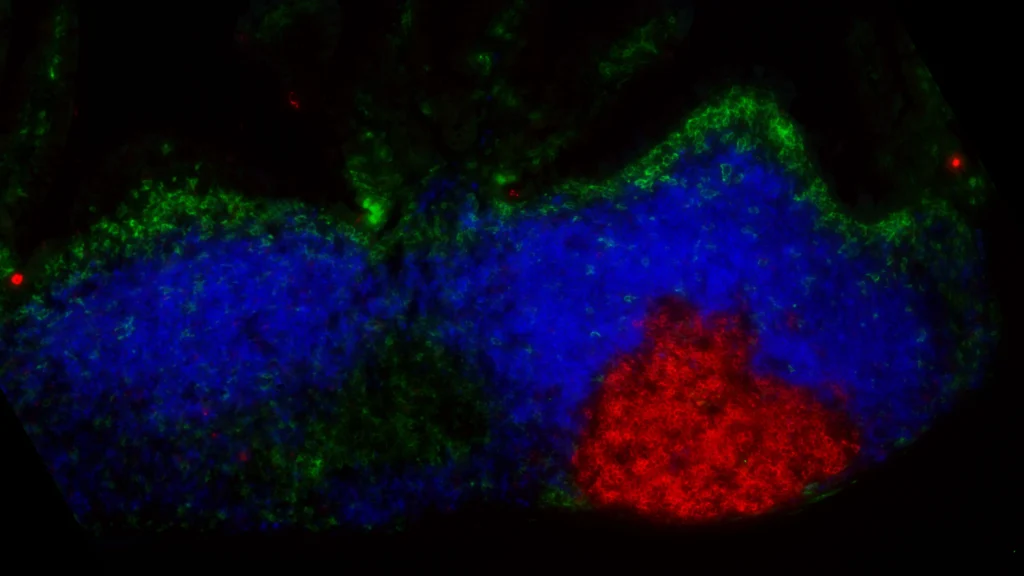
A Colton-supported Yale study has uncovered a second pathway for gut IgA antibody production, revealing a built-in immune backup system with significant implications for mucosal vaccine design.

Yale Researchers Identify Two New Therapeutic Targets for Fibrotic Diseases Like Scleroderma and Lupus
Research Findings
November 12, 2025

Yale Researchers Identify Two New Therapeutic Targets for Fibrotic Diseases Like Scleroderma and Lupus

Two Yale studies have identified a promising new antibody therapy and a previously unknown signaling pathway as potential treatments for fibrotic autoimmune diseases including scleroderma, lupus, and graft-versus-host disease.