

Project Overview

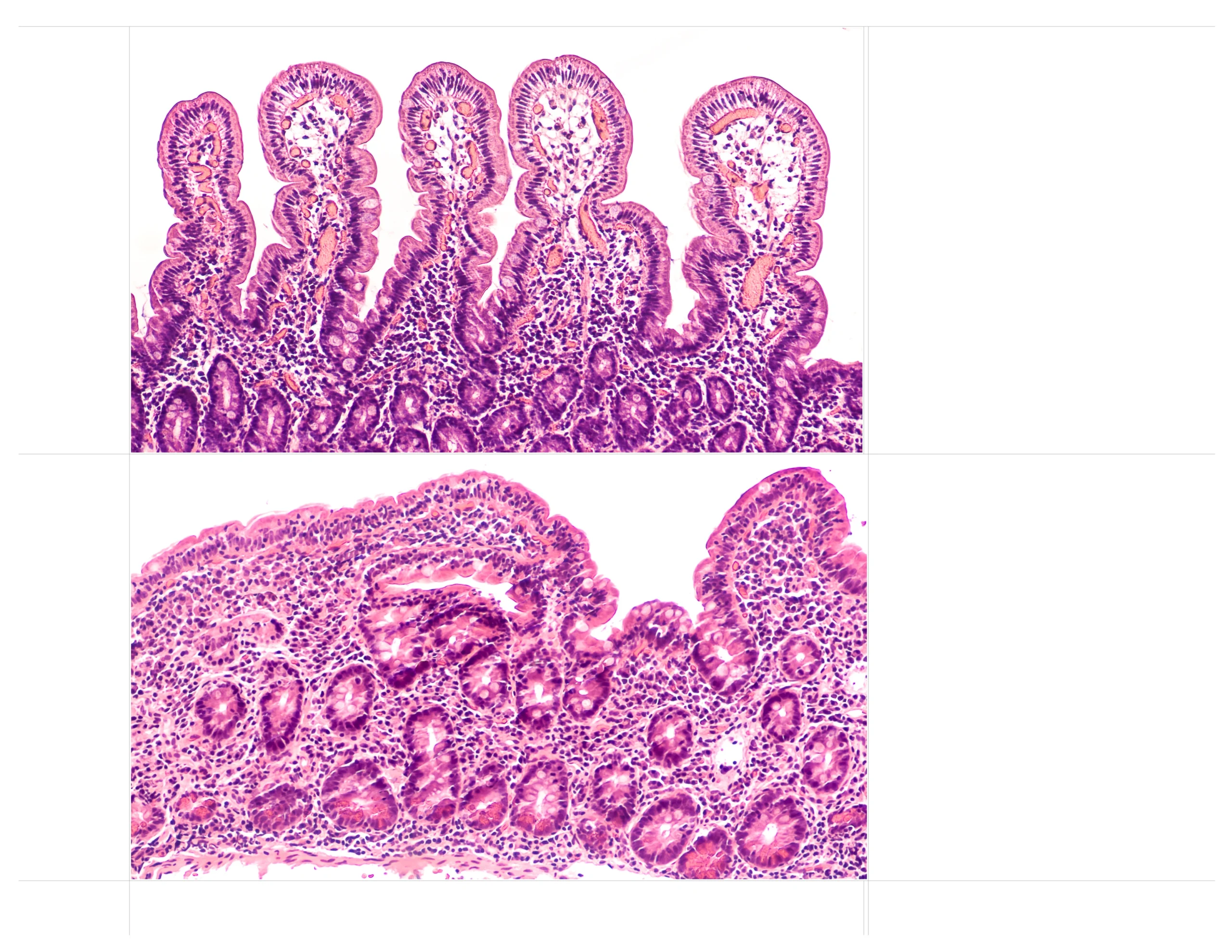
Celiac disease is an adaptive immune response to gluten proteins that damages the small intestinal lining, causing malabsorption of nutrients. Standard diagnostic biopsies are slow to reflect disease activity and may miss ongoing inflammation. This project investigates interferon gamma (IFNγ) — produced by T cells infiltrating the intestinal epithelium — as a molecular marker of disease activity. Data suggest that IFNγ-induced enterocytes produce signals that recruit and activate cytotoxic T lymphocytes (CTLs), which kill the enterocytes lining the small intestine. The IFNγ response signature, including CCL3, CCL4, CXCL10, CXCL11, and HLA-E-mediated CTL killing, is proposed as a "molecular microscope" capable of assessing CeD activity and therapeutic response without repeated biopsies.

Impact & Innovation

A molecular signature that reads celiac disease activity in real time.


By establishing IFNγ-induced enterocyte responses as a measurable proxy for disease activity and CTL recruitment, this project creates a molecular microscope that could replace or augment diagnostic biopsies across celiac and related immune-mediated intestinal diseases.

  • Identifies IFNγ-induced enterocyte signaling and HLA-E-mediated CTL killing as novel mechanistic drivers of CeD, with applicability to checkpoint inhibitor enteritis, colitis, and idiopathic IBD
  • Generates a platform for assessing pre- and post-treatment duodenal biopsies in clinical trials, with potential to serve as a diagnostic and monitoring tool across immune-mediated enteropathies
  • Advances the Consortium’s Shared Mechanisms Across Autoimmune Diseases pillar by identifying IFNγ-driven intestinal immune pathways shared across celiac disease, IBD, and immune-mediated colitis
Research Approach

A framework designed for discovery

This project combines intestinal tissue analysis, T cell biology, and molecular profiling to characterize IFNγ-induced enterocyte responses as a diagnostic marker of celiac disease activity and a mechanistic driver of CTL-mediated intestinal damage. The work moves from mechanistic discovery through biomarker validation and clinical trial application.

Modern tissue analysis techniques applied to small intestinal biopsies from CeD patients; characterization of IFNγ-induced enterocyte responses including CCL3, CCL4, CXCL10, CXCL11, and HLA-E expression; gluten peptide stimulation assays to trigger IFNγ responses; and CTL killing assays to evaluate HLA-E- and HLA-B-mediated enterocyte elimination by recruited T cells.

Small intestinal biopsy datasets from CeD patients, IFNγ response profiling data from villous enterocytes, CTL recruitment and killing assay datasets, and human immune system mouse models of celiac disease for comparative validation with human biopsy findings.

Validation of the IFNγ enterocyte response signature as a molecular microscope for CeD activity assessment, with translational applications including pre- and post-treatment biopsy analysis in clinical trials, collaboration with other consortium investigators, and expansion to checkpoint inhibitor enteritis, colitis, ulcerative colitis, and Crohn’s disease. A P01 grant application to NIAID is planned for June 2025.

Investigators & Institutions

Powering the science

Principal Investigators

Jordan Pober, MD, PhD, Colton Consortium Member

Bayer Professor of Translational Medicine, Deparment of Immunobiology, Yale School of Medicine, Yale University

Marie Robert, MD, Colton Consortium Member

Professor, Department of Pathology, Yale School of Medicine, Yale University

Research Outputs

From insight to impact

Publications

Opportunities for improving biopsy and non-biopsy-based diagnosis of celiac disease

Gastroenterology
Robert, ME; Ciacci, C; Lebwohl, B June 2024
Biomarker DiscoveryData-Driven & QuantitativeEarly Disease DetectionExperimental Platforms & ModelsHuman CohortsImmune ProfilingMulti-omics IntegrationReal-world EvidenceTranslational & ClinicalCeliac DiseaseGastrointestinal DiseasesYale University

T cell receptors for antigen on intraepithelial cytolytic T lymphocytes in celiac disease engage enterocyte HLA-E and HLA-B

Proceedings of the National Academy of Sciences
Johnson, JE; Agrawal, K; Al-Lamki, RS; Zhang, F; Wang, XD; Tobiasova, Z; Taleb, SA; Liburd, S; Rodriguez, L; Martins, AJ; Flavell, RA; Robert, ME; Sefik, E; Pober, JS February 2026
Adaptive ImmunityBioinformaticsBiological & MechanisticCytokine SignalingData-Driven & QuantitativeExperimental Platforms & ModelsHuman CohortsInnate ImmunitySingle Cell TechnologiesSpatial BiologyT Cell BiologyCeliac DiseaseGastrointestinal DiseasesYale University

The multiple roles of gamma interferon in intraepithelial T cell-villous enterocyte interactions in active celiac disease

bioRxiv [Preprint]
Johnson, JE; Agrawal, K; Al-Lamki, RS; Zhang, F; Wang, X; Liburd Jr, S; Tobiasova, Z; Rodriguez, L; Martins, AJ; Sefik, E; Flavell, RA; Robert, ME; Pober, JS September 2024
Adaptive ImmunityBiological & MechanisticCytokine SignalingExperimental Platforms & ModelsHuman CohortsIn Vitro ModelsInnate ImmunitySingle Cell TechnologiesT Cell BiologyCeliac DiseaseGastrointestinal DiseasesYale University

Additional Outputs

Astra Zeneca grant: $1,277,930 (Biomarkers and Pathogenesis of Immune-mediated Enteridities and Colitides: Celiac Disease vs. Check Point Inhibitor Enteritis and Colitis vs. Idiopathic Inflammatory Bowel Disease, 2024–2027). MPIs: Jordan Pober, Marie Robert, and Andrew Martins.